An API, or Application Programming Interface, is a way for different programs to talk to each other. Think of it like a waiter in a restaurant. You tell the waiter what you want (a request), the waiter asks the kitchen to prepare it (processes the request), and then the waiter brings the food back to you (the response). APIs do the same thing but with data—helping websites and apps get information or services from other programs in a standardised way.

How APIs Are Used Today (And Why They’re Better)
Before APIs became widespread, sharing data between systems was time-consuming. Developers had to write custom integrations, establish database connections or use scripts to transfer XML files between systems using technologies such as FTP to exchange data at set times. This process was slow, prone to errors, often not real-time and painful to maintain.
Web APIs changed this by providing a standardised way for websites and apps to exchange data. Instead of building everything from scratch with the company they want to use, developers can use published APIs.
For example:
- Before APIs: A company needs to manually upload a CSV or XML file at the end of every day to the delivery company with the shipment details of every parcel they are sending
- Now With APIs: Every time an order is packaged, the Postal Company is immediately notified in real-time of the order information and can begin planning its journey to the customer before it is even picked up.
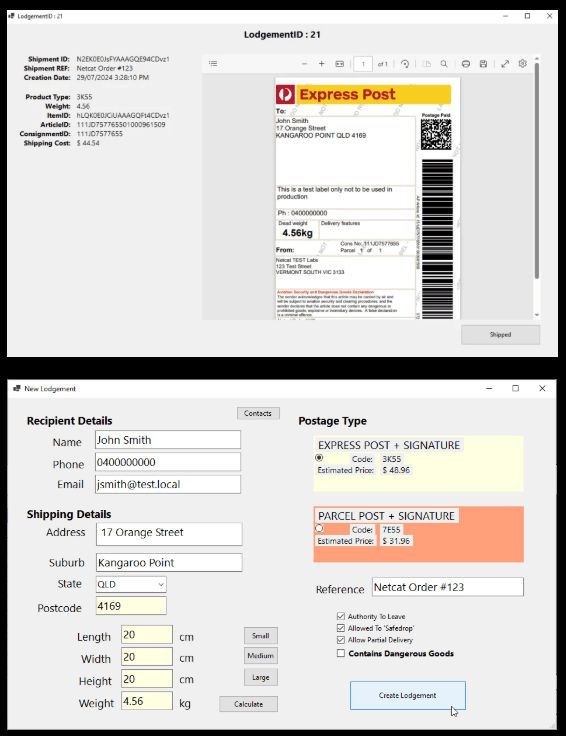
There are countless example of these API’s being used in every sector including:
- E-Commerce: PayPal and Stripe provide APIs so different platforms can handle online payments securely and easily.
- Transport & Logistics: Postal providers are notified immediately of shipments
- Weather: APIs like OpenWeatherMap provide real-time forecasts for different websites and apps.
- Maps: Google Maps API provides directions, traffic updates, and location data for apps like Uber or food delivery services.
- Technology: Company’s may use the Amazon EC2 API to automatically rent additional servers and scale up performance during peak times.
- AI: Devices and applications connect to AI services like ChatGPT via API to answer responses
How Do Web APIs Work?
Most web APIs work by sending and receiving data in a format called JSON (JavaScript Object Notation). JSON is lightweight, easy to read, and widely supported by most programming languages.
A simple practical of an API in action is the Online Solar Tools – Sun Position API.
For this example a solar tracker is asking the server where in the sky the sun is at, so it can aim its solar panels correctly. The Solar Tracker sends its current location using a POST request to the Endpoint (server), and the server responds back with a JSON containing the direction (azimuth) and angle (altitude) of the sun.

To make an API call, tools such as Postman and Bruno can be used and provide a nice visual interface for testing.
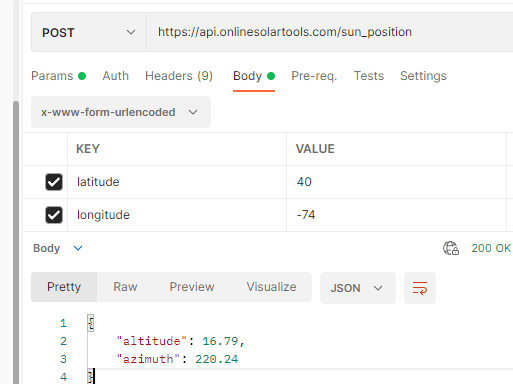
Alternatively API’s can be ‘called’ within programming language or by using command line tools such as Curl within scripts.

Key Parts of a Web API
Web APIs have a few important components:
- Endpoints: These are URLs where the API is accessed.
- Example:
https://api.onlinesolartools.com/sun_positionwill return sun position data for a specific location.
- Example:
- HTTP Methods: These are actions the API can perform:
- GET: Retrieve information (e.g., “Show me today’s weather”).
- POST: Send data to the API (e.g., “Save this user’s details”).
- PUT: Update existing information (e.g., “Change the user’s email”).
- DELETE: Remove data (e.g., “Delete this user’s account”).
- Authentication: Many APIs require a key or token to verify who you are (similar to a username & password). This ensures only authorized users can access the service to help prevent abuse or for billing purposes
- JSON Data: Web APIs often send and receive data in JSON format which can be easily processed .
For example the following JSON response:{"altitude": 16.79, "azimuth": 220.24 } - Documentation: Good APIs include detailed instructions, often using the OpenAPI format, explaining how to use them effectively. One of the best documented API’s is payment processor Stripe.
Wrap Up
Web APIs are the backbone of how modern online services connect. They allow apps to share data quickly and reliably in a standardised way. They allow developers to quickly integrate with other systems in ways the vendor expects. It is essential for IT professionals to understand that API’s exist and how to effectively use them.
What is your favorite API? Let us know in the comments below